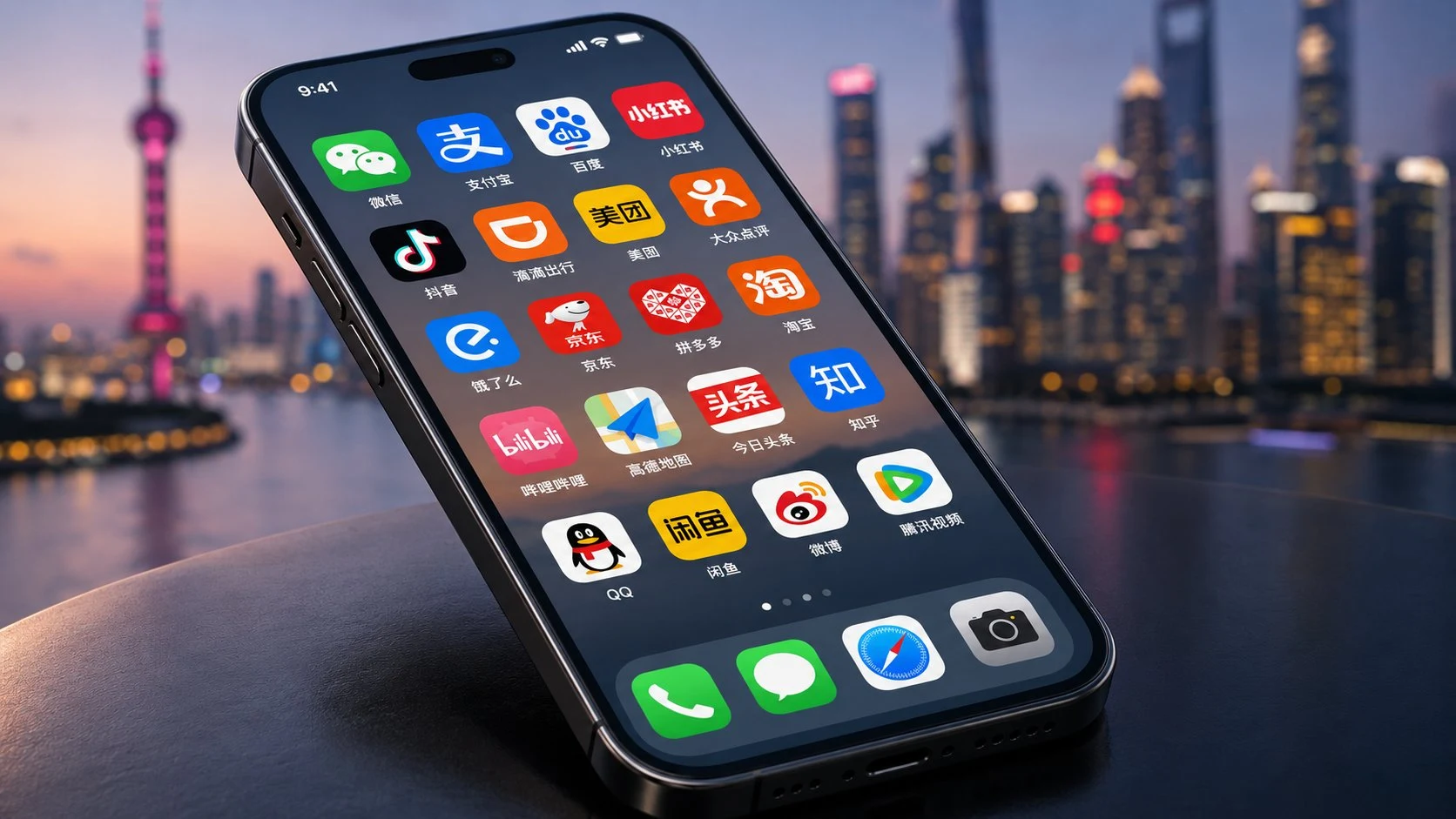
A different internet, a different world
China has its own digital ecosystem, largely separate from the rest of the world. Google is blocked, WhatsApp barely works, and Uber never took off. Instead, there's a set of local apps that do everything, and they do it very well. As a Chinese learner, getting familiar with these apps gives you a real window into how people actually live and talk.
Each of the apps below has a Chinese name worth knowing. Most of them are descriptive: the characters tell you exactly what the app does. That's typical of Chinese, and it makes learning vocabulary through real-world context much more effective than memorising lists.
The big ones

China's super-app. Messaging, payments, mini-programs, work communication, ordering food: it does everything. If you're learning Chinese, you'll almost certainly be using it to chat with Chinese contacts. The name literally means "micro message": 微 (wēi) = micro, 信 (xìn) = message/letter.

The other major payment app, made by Alibaba. The name tells you exactly what it is: 支付 (zhīfù) = payment, 宝 (bǎo) = treasure. If you're visiting China as a foreigner, the international version of Alipay is your easiest way in to mobile payments.

China's Google. The name comes from a Song dynasty poem and means "hundreds of times": the idea of searching endlessly until you find what you need. As a learner, Baidu is useful for looking up Chinese character explanations, example sentences, and authentic usage.

China's dominant food delivery and lifestyle app. You can order food, book hotels, buy cinema tickets and get groceries delivered, often in under 30 minutes. 美 (měi) means beautiful, 团 (tuán) means group or team. Learning to navigate Meituan in Chinese is excellent real-world reading practice.

China's Uber. The name 滴滴 imitates the sound of a car horn: a playful piece of sound symbolism (象声词, xiàngshēngcí) that Chinese uses a lot. Knowing how to communicate your destination in Chinese through the app, or directly to a driver, is one of the most practical skills you can develop.

TikTok was originally built for the Chinese market as 抖音, which means "vibrating sound" or "trembling beat": 抖 (dǒu) = to shake/vibrate, 音 (yīn) = sound/music. The international version became TikTok but in China everyone uses Douyin. For learners, following Chinese creators on Douyin is one of the best ways to hear natural, fast, colloquial Mandarin.

China's biggest online marketplace: think eBay meets Amazon, but bigger. The name means "digging for treasure": 淘 (táo) = to sift/search, 宝 (bǎo) = treasure. Browsing Taobao entirely in Chinese is genuinely great reading practice: product descriptions, user reviews and seller chat are all authentic, unfiltered Mandarin.

Part Instagram, part Pinterest, part product review site. Young Chinese women in particular use it to share lifestyle content, travel tips, beauty routines and restaurant recommendations. The name is wonderfully literal: 小 (xiǎo) = little, 红 (hóng) = red, 书 (shū) = book. For Chinese learners it's one of the most useful apps out there. The posts tend to be short, visual and written in modern, natural Mandarin. Searching for topics you already know in English (travel destinations, food, study tips) and then reading about them in Chinese is genuinely excellent practice.
Why this matters for your Chinese
Every one of these apps is a Chinese classroom. The menus, buttons, notifications and error messages are all in Chinese. When you set your phone language to Chinese and start using Meituan to order lunch or WeChat to message your teacher, you're doing something no textbook can replicate: reading real Chinese under mild pressure, in context, where it actually matters.
A good exercise: pick one app and switch it to Chinese. Start with something low-stakes like 网易云音乐 (Wǎngyī Yún Yīnyuè, NetEase Music) or 哔哩哔哩 (Bìlì Bìlì, Bilibili, China's YouTube for younger audiences). You don't need to understand everything. Just spend ten minutes a day in Chinese-language digital space. It adds up faster than you'd think.